
Spider Control in Las Vegas, NV
Protect your property with expert spider removal—request your free inspection today.
- Ants & rodents
- Straightforward pricing
- Local technicians
Call for a rate estimate
- Fast, courteous service
- Clear, upfront pricing
Our local team is taking calls now.





Always Available:
Las Vegas spiders don't keep business hours, and neither do we. Reach out anytime for immediate assistance with your spider problem!
Licensed & Experienced
Our certified technicians bring years of desert pest expertise to every spider control job in the Las Vegas valley!
Customized Solutions
Every property faces unique spider challenges. We design treatment plans specifically for your situation and schedule!
Spider Control in Las Vegas
Most of what turns up in a Las Vegas house is harmless and arrived following something else. Spiders are predators, so a property with a spider problem almost always has an insect problem underneath it — and treating the spiders without touching what they are eating gets you a quiet fortnight. The exception worth taking seriously is the western black widow, which is genuinely common across the valley and lives in exactly the places people reach into without looking.
The Species That Matter Here
Western Black Widow
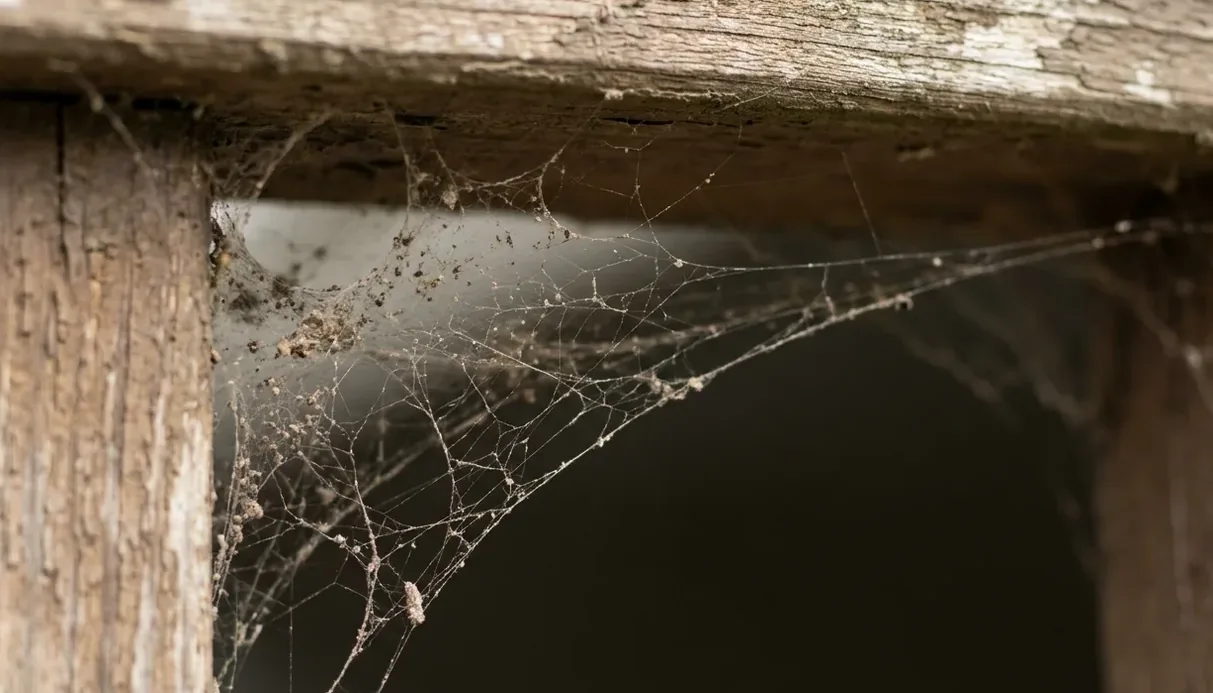
Glossy black, with the red hourglass on the underside of the abdomen. They favour dry, dark, undisturbed voids close to the ground: block wall cavities, water meter and irrigation valve boxes, the underside of patio furniture, the gap behind a stack of stored pots, and the corners of a garage where boxes have not moved in a year. Their web is not a neat orb but an untidy tangle, and it is noticeably tougher than it looks. Bites are uncommon and usually defensive — the classic circumstance is a hand put into a meter box or a pot lifted off a shelf.
Desert Recluse
Southern Nevada does have a native recluse species, but it is far rarer in houses than the internet suggests and it prefers undisturbed desert and outbuildings to occupied homes. Misidentification is routine: most spiders sent to us as recluses are harmless. If you have a spider you are worried about, keep it rather than crushing it and we will look at it properly.
Everything Else
Cellar spiders, jumping spiders, wolf spiders and the various web-builders that come in during a temperature swing. These are the majority of calls and they are not a threat to anybody.
Why De-Webbing on Its Own Does Not Work
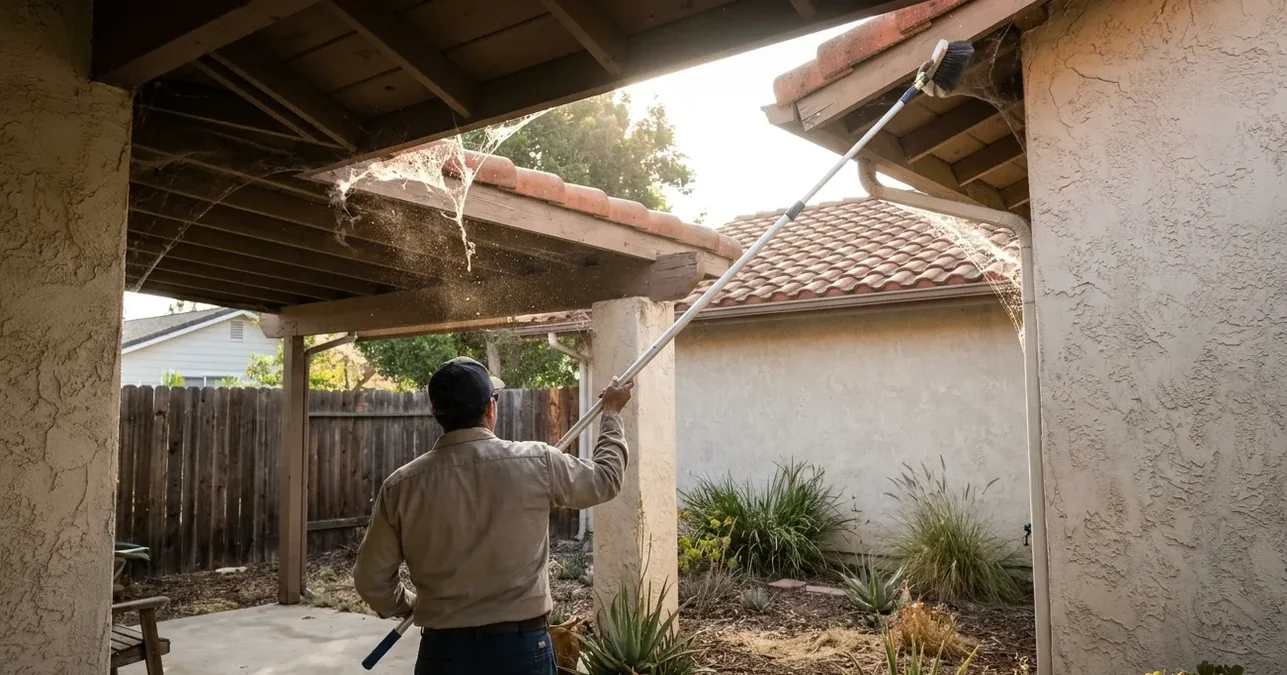
Clearing webs makes a property look better immediately and changes nothing about why the spiders were there. They return within days because the food supply and the harbourage are unchanged. Web removal is part of the job — it takes away egg sacs and gives us a clean baseline to judge activity against — but it is the first step, not the treatment.
Our Spider Control Process
Inspection and Identification
We work the perimeter, the eaves and the covered areas, and we specifically open the boxes and voids where widows live: meter and valve boxes, block wall weep holes, the underside of patio and pool furniture, and stored items along a wall. We identify what is present rather than treating for a generic spider.
De-Webbing and Egg Sac Removal
Webs and egg sacs come down mechanically. A widow egg sac holds a few hundred spiderlings, so removing them physically is worth more than any product.
Targeted Harbourage Treatment
Product goes into the voids and along the harbourage lines rather than being fogged across the yard. Spiders do not groom the way insects do and they have very little body contact with treated surfaces, which is why broadcast spraying disappoints — putting the treatment where they actually sit is what makes the difference.
Reducing the Food Supply
This is the part that produces a lasting result. We treat the perimeter and the areas where the insects that spiders eat are concentrating, and we talk to you about lighting, because outdoor lights are the single biggest driver of spider activity on a Las Vegas property.
Exclusion
Door sweeps, weep screed gaps, garage door corner seals and the penetrations where utilities pass through a wall. The same work that keeps scorpions out keeps spiders out, and on most properties we are doing both at once.
Recognising a Spider Problem
Tangled Webbing Low and in Corners
Untidy, strong, close-to-ground webbing in a garage corner, under a patio bench or against a block wall is the widow signature. Neat wheel-shaped webs across a doorway belong to harmless orb weavers.
Papery Egg Sacs
Round, off-white, roughly the size of a pea, suspended in the web. Finding several means a resident female rather than a wanderer.
Spiders Indoors in Numbers
A single spider in the bath is normal. Several a week is a signal about the insect population and the exterior lighting, not about the spiders.
Heavy Insect Activity at Night
Moths and midges around exterior lights are what draws and feeds spiders. Where we see that, the lighting conversation matters more than the treatment.
Lighting, and Why It Matters More Than People Expect
White and blue-white exterior lighting pulls flying insects from a considerable distance, concentrates them against the wall of the house, and reliably produces a band of spider webbing across the front of the property. Switching exterior fittings to warm amber or true yellow lamps, moving a light away from the door it illuminates, or putting it on a motion sensor rather than dusk-to-dawn will do more for a chronic spider problem than repeat treatment will. We would rather tell you that than sell you a schedule.
Keeping Them Out After Treatment
Keep stored items off the garage floor and away from the walls. Wear gloves when opening a meter or irrigation box, and knock a pot before you lift it. Keep firewood and building materials away from the house. Shake out shoes and gloves that have been in a garage. Between the lighting change, the exclusion work and a treated perimeter, most properties hold well between visits.
Where Spiders Actually Live on a Las Vegas Property
Block Wall Voids and Weep Holes
The perimeter wall around almost every yard in this valley is hollow, shaded and continuous, and the weep holes along its base open straight into that cavity. It is close to ideal widow habitat and it runs the entire length of the property line. Treating it properly means putting product into the voids rather than along the face of the wall.
Meter, Irrigation and Valve Boxes
Dark, dry, rarely opened, and at ground level. If you take one lesson from this page, make it gloves before you lift a box lid.
Under Patio and Pool Furniture
The underside of a table, the frame of a stacked chair, the inside of a folded umbrella. Furniture that has not moved since last summer is worth checking before anybody sits down.
Stored Pots, Boxes and Firewood
Anything stacked against a wall and left alone. Widows favour the gap between two objects rather than open shelving.
Garage Corners and Roller Door Tracks
The corners behind stored items, and the channel the door runs in. Garages are the single most productive place we look on a residential job.
Eaves, Patio Beams and Covered Ceilings
The web-builders that are not widows collect overhead wherever there is a light nearby. This is the webbing people actually see, and it is the least significant of the lot.
If Someone Is Bitten
We are a pest control company and not a medical service, so the useful thing we can tell you is this: a suspected widow bite is a reason to seek medical advice, particularly for a child, an older adult, or anyone who develops cramping or spreading pain rather than a local reaction. Bites are uncommon and are usually defensive — a hand into a meter box, a pot lifted off a shelf. If it is practical and safe, keep the spider so it can be identified, because a great deal of unnecessary worry comes from misidentification. Do not put yourself at risk to catch it.
Seasonal Pattern in the Valley
Spring
Egg sacs laid the previous autumn hatch, and spiderlings disperse. This is the cheapest moment in the year to deal with widows, because removing a single sac now removes a few hundred spiders later.
Summer
Insect activity peaks around exterior lighting and the spider population follows it. Widows move deeper into shaded voids during the hottest part of the day and are most active well after dark, which is why people meet them when taking bins out rather than at dusk.
Autumn
The busiest season for calls. Mature females are at their largest and most visible, webbing is at its heaviest, and cooler nights push more insects toward the warm face of the building. Anything indoors now came in following food.
Winter
Activity drops but does not stop — there is no cold here that clears them out. Widows overwinter in the same block wall voids and meter boxes and re-emerge as soon as nights warm.
Things Not To Do
Do not burn webs off an eave, which every year causes house fires that were entirely avoidable. Do not use a bug bomb: spiders have minimal contact with treated surfaces, so a fogger achieves almost nothing against them while killing a great deal of harmless insect life indoors. And do not assume that finding a large spider means finding a dangerous one — the overwhelming majority of what we are shown is harmless, and identification takes a minute.
Getting the Most Out of a Visit
Tell us where you have actually seen spiders and at what time of day, because that narrows the search considerably. Unlock the side gate and clear access to meter and irrigation boxes, the garage perimeter and any stored items along a wall — those are the places worth opening, and a visit that cannot reach them is a visit spent on the least productive parts of the property. If you have a spider you were worried about, keep it in a container rather than crushing it; identification takes a minute and it settles the question properly.
★ FAQ
Frequently Asked Questions
Las Vegas properties frequently encounter cellar spiders (daddy longlegs), wolf spiders, jumping spiders, and common house spiders. While these species are generally harmless, our desert climate also supports black widow spiders and desert recluse spiders—both venomous species requiring professional removal. Black widows build irregular webs in garages, sheds, and outdoor storage areas, while desert recluses hide in undisturbed indoor spaces like closets and attics.
Extreme summer heat drives spiders indoors seeking cooler temperatures and moisture. As outdoor temperatures exceed 110°F, spiders migrate toward air-conditioned spaces and water sources around your property. Additionally, outdoor lighting attracts flying insects that serve as spider food sources, drawing spiders closer to structures. Professional spider control creates protective barriers preventing this seasonal migration indoors.
Black widow spiders are Nevada's most medically significant spider species. Their venom contains neurotoxins that can cause severe muscle pain, cramping, and respiratory difficulties requiring medical attention. While fatalities are rare, children, elderly individuals, and those with health conditions face greater risk. Black widows typically bite only when threatened, but their presence around homes—particularly in areas children and pets access—requires immediate professional removal.
We use EPA-registered products specifically designed for residential spider control with excellent safety profiles when applied correctly. Our licensed technicians follow strict application protocols minimizing exposure while maximizing spider elimination. Most treatments require only brief periods away from treated areas, and we provide clear safety instructions for your specific service. Many clients with children and pets choose our services specifically for safer spider removal than DIY methods.
Effective spider prevention includes sealing cracks around windows, doors, and foundation areas where spiders enter. Remove clutter in garages, closets, and storage areas that provide spider hiding spots. Keep outdoor vegetation trimmed away from your home's exterior, and consider switching to yellow or sodium vapor outdoor lights that attract fewer insects. Our maintenance programs include regular preventive treatments and inspections to maintain long-term spider control.
Comprehensive spider inspection examines both interior and exterior areas where spiders establish territories. We check basements, attics, closets, garages, and storage spaces for active spiders, webs, and egg sacs. Exterior evaluation includes foundation perimeters, eaves, outdoor structures, and vegetation. We identify spider species present, assess population levels, locate entry points, and evaluate conducive conditions. This thorough assessment allows us to design the most effective treatment strategy for your specific situation.
📍 On the map
Our Complete Spider Control Process
Proven methodology ensures thorough elimination and lasting protection
Our detailed spider control approach addresses current infestations while implementing preventive measures that keep spiders from returning to your Las Vegas property.