
Rodent Bait Stations in Las Vegas, NV
Exterior tamper-resistant stations, placed and maintained properly on properties that genuinely need them
- Rodent control
- Straightforward pricing
- Local technicians
Get a price for your property
- Fast, courteous service
- Clear, upfront pricing
A Las Vegas technician is on the line now.





Outside, in Locked Stations
Secured, anchored and tamper-resistant, on the routes the animals use. Never loose bait, and not inside your home.
Where They Earn It
Sustained pressure from open desert, commercial sites, ongoing monitoring. We will say when trapping is the better answer.
Serviced and Logged
Checked, replenished and recorded on a schedule, so the stations tell you something instead of sitting there.
Rodent Bait Stations in Las Vegas
Rodenticide is a tool with a narrow correct use and a very wide incorrect one. Used as a maintained perimeter on a property under constant outside pressure, it does something nothing else does as cheaply. Used as a first response inside a house, it creates a worse problem than the one it was brought in for.
We would rather set out the reasoning than simply list a service, because a good deal of what gets sold as rodent control in this valley is a monthly bait round on properties that needed sealing instead.
Why Nothing Goes Inside
The decisive fact about bait is that it does not kill at the station. An animal feeds, and dies somewhere between one and several days later, wherever it happens to be at the time. For a roof rat that means the roof void or a wall cavity. For a mouse it means the nest, which is behind an appliance or inside insulation.
In this climate that becomes serious quickly. A carcass in a sealed cavity in July produces an odour that permeates a house within days and a fly population shortly after, and the only real remedy is opening up the structure to locate it — cutting drywall, lifting insulation, working out from the smell. We have been called to do exactly that on houses where somebody put bait in the attic, and it is a far more expensive and disruptive job than the trapping would have been. It is why Rodent Control Las Vegas treats rodenticide as one tool among several rather than the default.
So interior rodent work is trapping. With a trap we know where the animal is, because it is in the trap.
Where Stations Genuinely Earn Their Place
There are properties where a maintained exterior perimeter is the right answer, and they have a common characteristic: pressure that renews itself regardless of what you do to the building.
- Homes on the desert edge, where open ground keeps producing animals season after season
- Properties beside active grading or construction, where every phase displaces whatever was living on the cleared ground
- Commercial sites with bin stores, grease traps, loading bays and doors that stand open through the working day
- Large or complex sites where knowing where pressure is coming from matters as much as reducing it
- Buildings that have been trapped out and sealed, where the remaining job is holding a boundary rather than solving an infestation
What all of those have in common is that the building is not the source. Where the building is the source — an open fascia line and a nest in the void — a station outside is treating the wrong thing.
The Stations Themselves
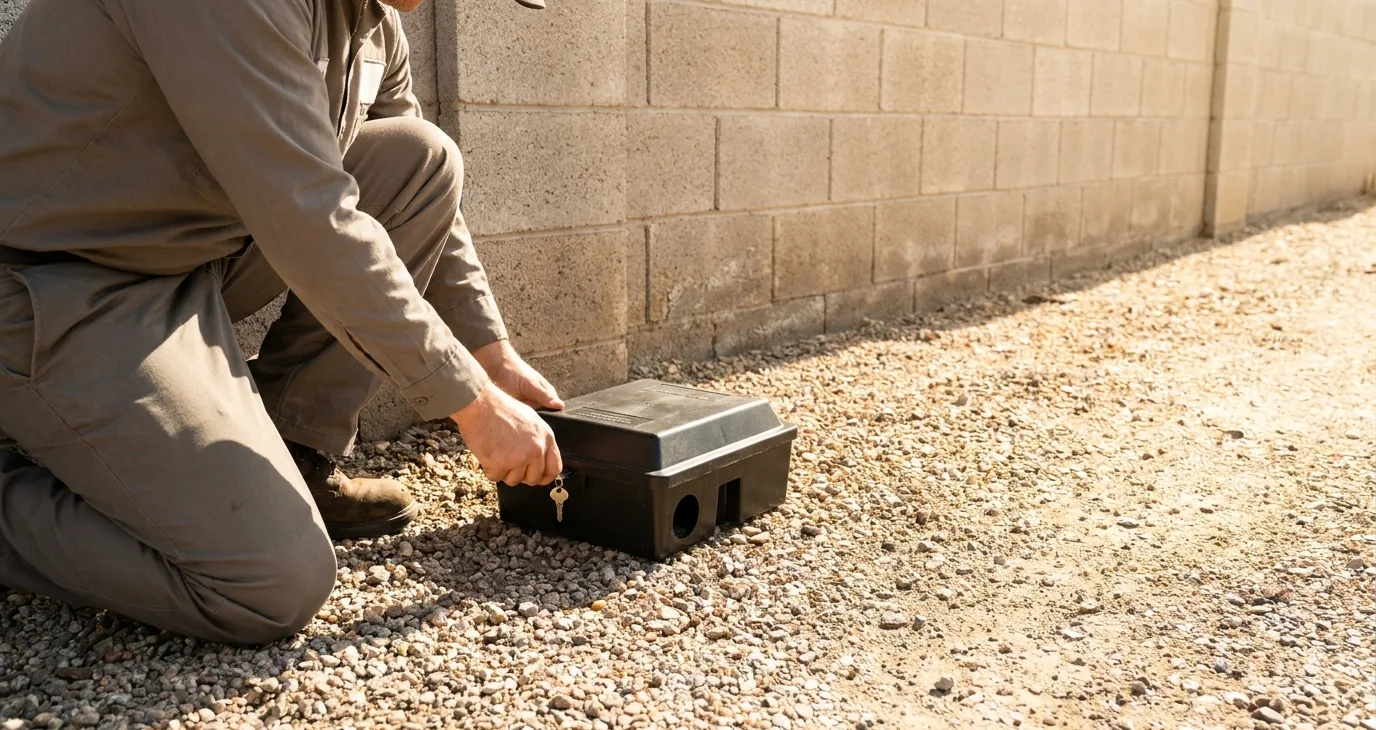
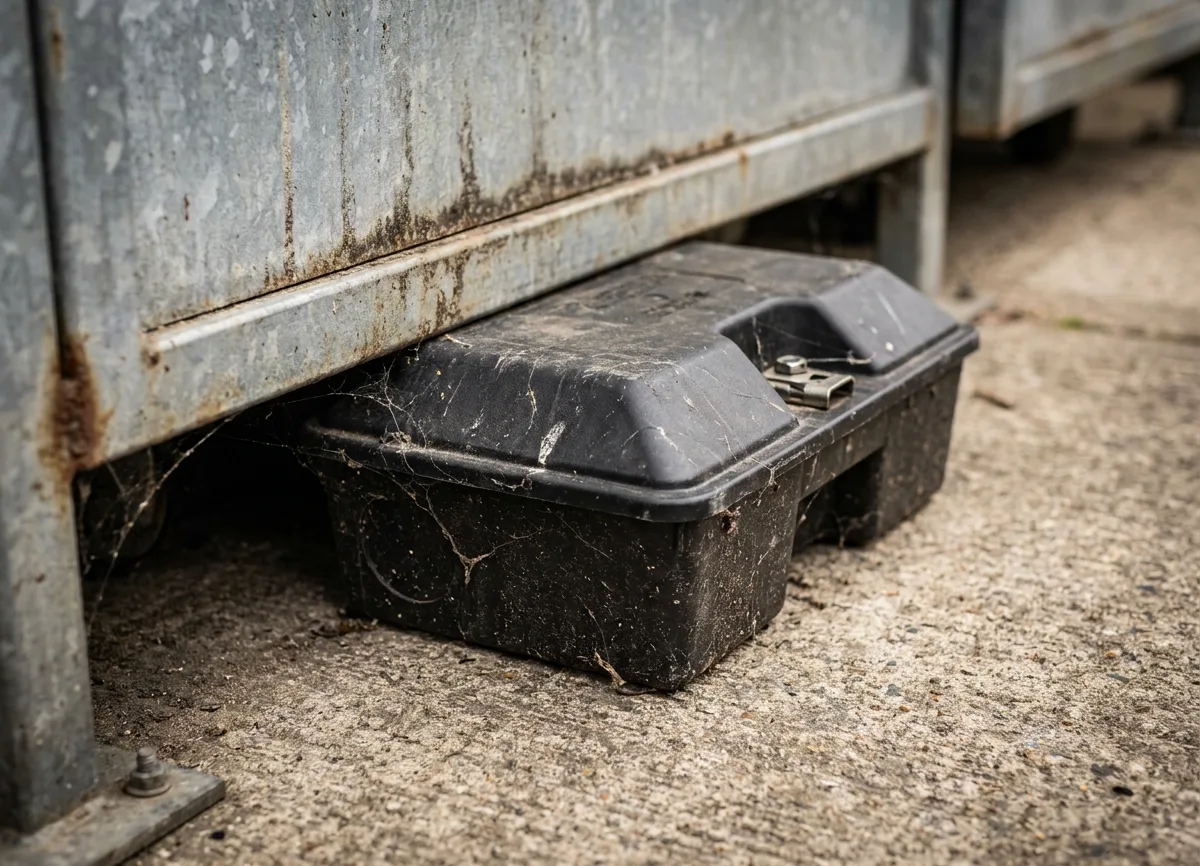
Tamper-resistant, locked, and anchored so they cannot be moved, tipped or opened without a key. Bait is secured inside on rods rather than loose, so it cannot be dragged out and cached somewhere else on the property. Nothing we place is ever loose bait scattered in a garden or a void, which is both illegal in most circumstances and indefensible in all of them.
Placement follows the same logic as trapping: against walls, at the base of structures, along the routes the animals are already using. Stations spaced evenly around a perimeter for the sake of appearances catch far less than a smaller number sited where the rub marks and droppings say the traffic is.
Pets, Children and Wildlife
The stations are locked and anchored and go in service areas and against walls rather than in open garden. That is the design answer, and it is a good one.
The honest answer is that no rodenticide programme is entirely without risk, and we would rather say that than recite a safety line. If you have a dog that investigates everything or small children who play across the whole garden, tell us. It changes where stations go, and on some properties it is a reason to recommend against baiting altogether and do more trapping and sealing instead.
The Owls Are Not a Detail
Anticoagulant rodenticides pass up the food chain. A rat that has fed on bait and is slowing down is an easy catch, and what eats it takes the dose.
The Las Vegas valley has barn owls, great horned owls, red-tailed hawks, kestrels and coyotes, and every one of them hunts the rats we are called about, continuously, for nothing. Poisoning that population out is both bad in itself and counterproductive: raptors are a genuine part of what keeps roof rat numbers down across a neighbourhood, and a property that has removed its predators has made itself more dependent on paid intervention, not less.
This is the main reason our use of bait is restrained. It is not squeamishness — it is that the tool has real costs, and on most residential jobs trapping and exclusion do the work as well or better without them.
Servicing Means Reading, Not Topping Up
A station nobody reads is decoration. Servicing on a monthly cycle for commercial work, or at whatever interval a residential property genuinely warrants, means checking condition, replenishing where there has been take-up, and recording station by station what has happened.
That record is the valuable part. Which stations are being hit, how heavily, and how that changes month to month tells you the direction pressure is coming from, whether a neighbouring site has started producing animals, and — importantly — whether your exclusion is still holding. A perimeter that goes quiet after sealing work is evidence the sealing worked. A perimeter that stays busy on one side of a building is a map.
Where documentation is needed for an inspection or audit regime, that is what it is drawn from, and it is kept in a form that satisfies one.
What Stations Will Not Do
They will not close the opening an animal used. They will not remove a population already nesting in a roof void. They will not clean up contaminated insulation, and they will not stop the wiring being gnawed.
On a building with an active infestation, a bait programme on its own is a way of paying monthly while the underlying problem continues. If a company has been servicing stations at your property for a year and the noise in the ceiling has not changed, that is what is happening.
Knowing When to Stop
We review programmes rather than renewing them automatically. A house that was trapped out, sealed properly and has had a quiet perimeter for two service cycles frequently does not need stations any more, and the right advice is to stop — possibly keeping non-toxic monitoring in place so that a change would be noticed.
Recommending less work is not a difficult conversation to have. It is considerably easier than explaining, a year in, why nothing has changed.
★ FAQ
Frequently Asked Questions
Because of where the animal dies. Rodenticide does not kill at the bait -- it kills a day or more later, wherever the animal happens to be, which for a roof rat or a mouse means inside a wall cavity or a roof void. In a Las Vegas summer a carcass in a cavity is a severe odour and fly problem for weeks, and the only real remedy is opening up the structure to find it. Interior work is trapping, where we control where the animal ends up.
Exterior pressure that keeps renewing itself. A property backing onto open desert or active grading. Commercial sites with bin stores and constant deliveries. Large or complex sites where monitoring the perimeter matters as much as killing anything. Situations where trapping has cleared the building and the job is now holding a boundary rather than solving an infestation.
The stations are tamper-resistant, locked, and anchored so they cannot be moved or opened without a key, and they are placed against walls and in service areas rather than in open garden. That said, the honest answer is that no rodenticide is entirely without risk, which is exactly why we treat it as one tool among several rather than the default. If you have a dog that investigates everything, tell us and we will factor it into placement -- or recommend against baiting altogether.
It is a genuine concern and worth taking seriously. A poisoned rodent can be eaten by whatever hunts it, and anticoagulants pass up the chain. The valley has barn owls, great horned owls, red-tailed hawks and coyotes that hunt these same rats for free, and it is not in anyone's interest to remove them. It is one of the main reasons we keep baiting restrained and prefer trapping and exclusion where they will do the job.
Monthly on most commercial work, and at whatever interval the situation actually warrants on a residential property. Servicing means checking and replenishing, but also reading them: which stations are being hit, how heavily, and whether that is changing tells you where the pressure is coming from and whether the exclusion is holding. A station nobody reads is decoration.
No, and we would rather say so at the outset. Stations manage pressure at a boundary. They do not close the opening an animal used, they do not remove a population already nesting in your roof void, and they do not clean up contamination. On a building with an active infestation, baiting alone is a way of spending money monthly without the problem ending.
On a lot of residential jobs, no. A house that has been trapped out and sealed properly frequently needs nothing further, and we will tell you that rather than adding a monthly line to the invoice. Where the surroundings keep sending animals -- desert edge, construction, a neighbouring property that is feeding a population -- that is when a maintained perimeter starts to make sense.
📍 On the map
How We Run Bait Stations in Las Vegas
Decide whether it is warranted, then place, service and read
The first question is whether stations are the right tool here, and often the answer is that trapping and sealing will do more. Where they are warranted, they go on the actual travel routes, anchored and locked, and every one is mapped. Servicing is a real check rather than a top-up: which stations are being hit and how heavily tells us where the pressure is and whether your exclusion is still holding.