
Rodent Entry Sealing in Las Vegas, NV
Permanent exclusion work in steel and metal, so the building stops admitting rodents rather than being cleared repeatedly
- Rodent control
- Straightforward pricing
- Local technicians
Get a price for your property
- Fast, courteous service
- Clear, upfront pricing
A Las Vegas technician is on the line now.





Steel, Not Foam
Anything soft gets chewed back open within a season. We close openings in materials rodents cannot get through.
The Whole Envelope
Sealing the hole you noticed just moves the traffic. We work the entire building so the route is gone, not relocated.
Photographed Both Ways
Every opening recorded before and after. Exclusion happens in places you will never see, so the evidence matters.
Rodent Entry Sealing in Las Vegas
This is the part of the work that decides whether you have a rodent problem again next year. Trapping empties a building. Sealing stops it filling back up. Everything else — the traps, the cleanup, the stations — is dealing with a symptom of a building that is open, and a property that gets cleared without being closed is a property on a repeat cycle.
It is also the part most often done badly, because it happens in roof voids, behind appliances and along fascia lines that nobody looks at, and because there is a material sold in every hardware shop that appears to do the job and does not.
The Foam Problem
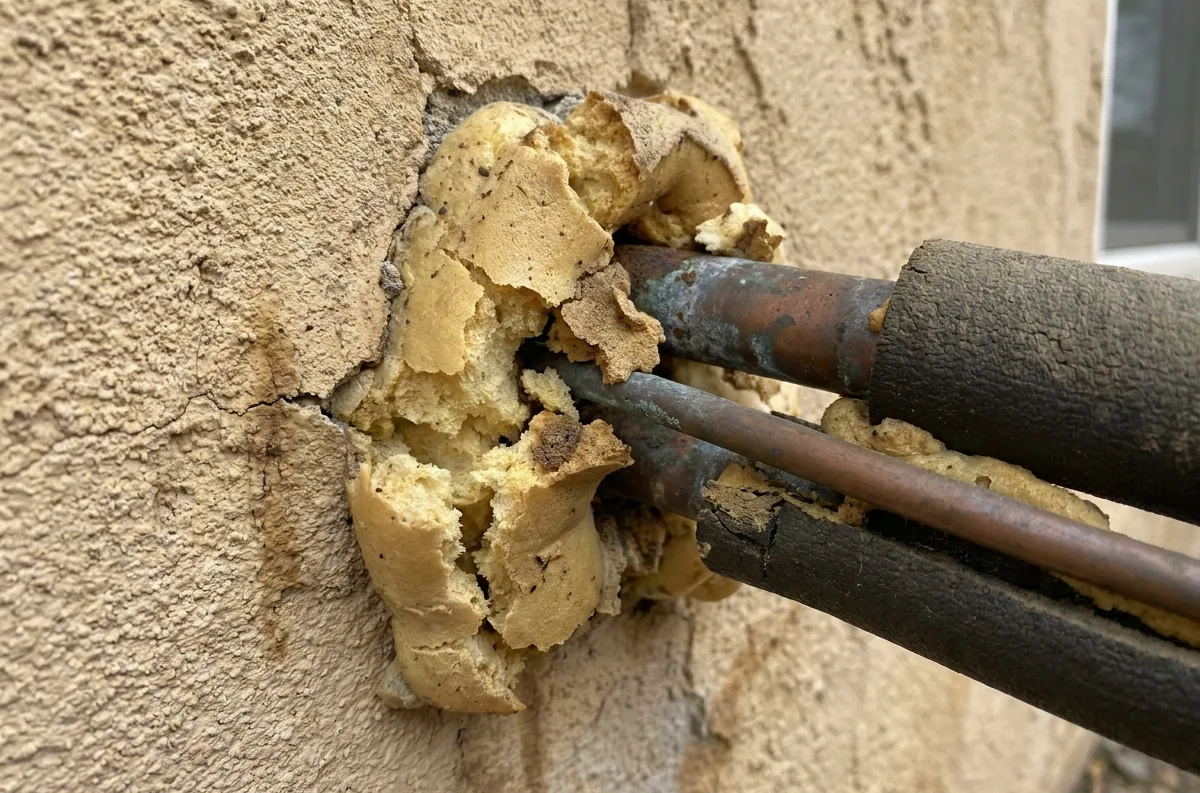
Expanding foam is the single most common thing we find when we are called to a building somebody has already attempted to seal. It sprays into any shape, it cures hard enough to feel solid, and it looks like a finished job.
Rodents chew through it without difficulty. Cured foam is soft, it holds no structural resistance against incisors that are designed to work timber, and an animal that used an opening before will return to that same opening — scent trails persist, and rodents are creatures of established routes. What you get is a seal that holds for a season or two, long enough for everyone to believe the problem was solved, and then a reinfestation that looks like a new event and is not.
Foam does have a legitimate use here. Packed behind a metal barrier it fills the void, blocks draughts and seals against water and insects. It belongs in the assembly. It does not belong as the thing standing between an animal and your roof void.
What We Close Openings With
The rule is that the barrier is always metal or masonry, and everything else is backing or finish.
- Galvanised steel mesh and hardware cloth — cut to shape and mechanically fixed for anything of size. Fixed, not pushed into place; a mesh plug that can be worked loose is not a seal.
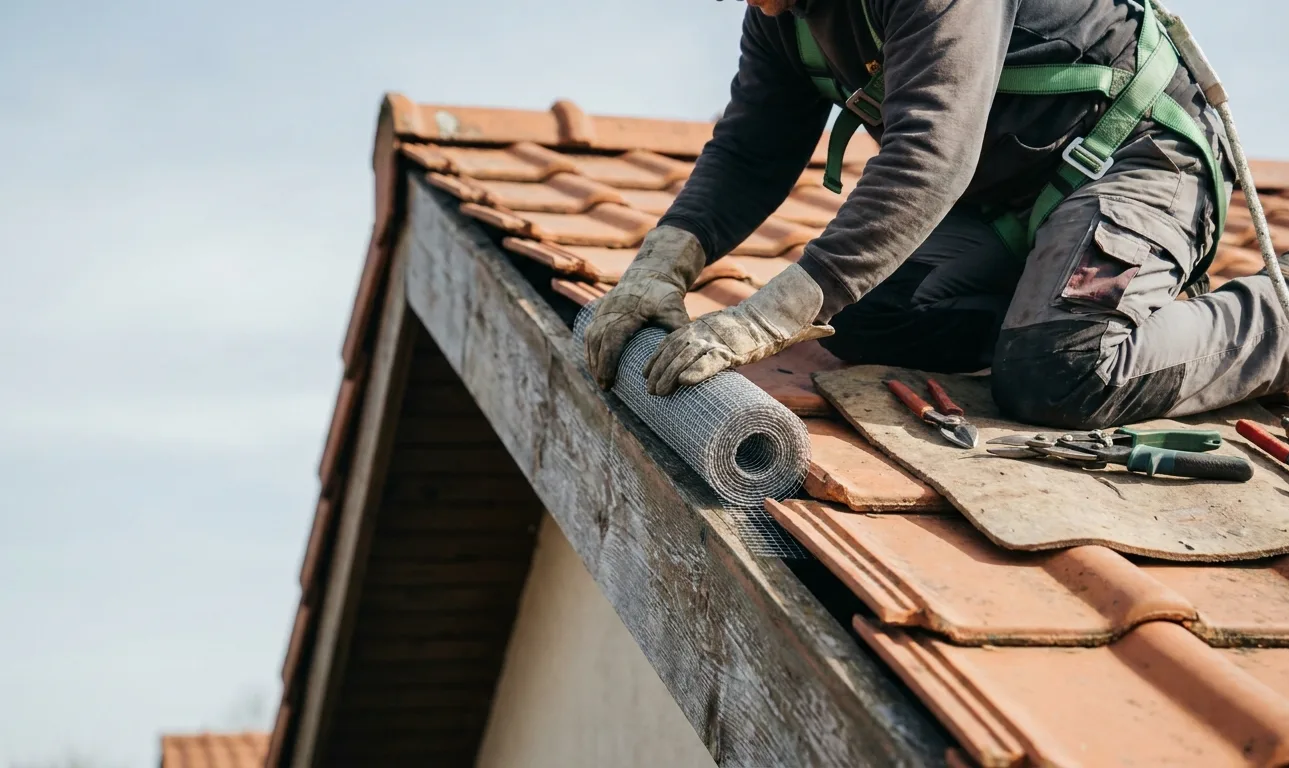
- Metal flashing and sheet — for runs that need closing along their length, which on valley housing usually means the gap where a tiled roof meets the fascia.
- Stainless or galvanised wool — packed tight into small penetrations around pipework and cabling, backed with sealant so it stays compressed.
- Purpose-made metal vent covers — where screening has perished, replacing rather than patching, because a patched screen fails at the patch.
- Mortar and concrete — at ground level, where a gap at a slab edge or a footing needs filling permanently.
The Openings on a Valley House
Las Vegas housing stock is consistent enough that the list barely changes from property to property. What varies is how many of them a given building has.
The Garage Door Corners
The two bottom corners of a roller door, where the seal lifts away from the concrete, are probably the most-used rodent entrance in the valley. The gap is small, it is at ground level, it is in shadow, and almost nobody looks at it. Garages then connect to wall cavities and often directly to the house.
The Fascia Gap
On a great many tiled roofs here, the point where the tiles meet the fascia board is open along the entire run. From the ground it reads as a shadow line. From a ladder it is a continuous opening into the roof void, and for a climbing animal it is the obvious way in. Closing it properly means working along its length in metal, not plugging the section above where you heard noise. Every opening Rodent Control Las Vegas closes is photographed before and after for exactly this reason.
Vents
Attic vents, gable vents, dryer outlets and bathroom extract terminations all have screening that perishes in this sun. Once the mesh has gone brittle and broken, the vent is simply a hole with a decorative cover.
The Line Set
Where the air-conditioning refrigerant lines enter the wall there is a penetration that was, on most houses, sealed once with foam at installation. That foam is now some years old and frequently perished, cracked away from the render, or already opened up.
The Weep Screed
The metal edge at the bottom of a stucco wall is designed to let moisture out, and it leaves a deliberate gap. Where landscaping, gravel or raised soil has been built up against it, that gap becomes a sheltered ground-level entrance — and burying it also stops it doing the job it was there for.
Penetrations Inside
Under sinks, behind washing machines, at the water heater, wherever a pipe or a cable was pushed through a wall and the hole was never made good. These matter most for mice, which need a quarter of an inch, and they are the ones that get missed because they are behind something.
Sequence Matters
Animals come out before the building gets closed. This is not a preference, it is the one part of the order of work that cannot be varied.
Sealing a structure with an active population inside it traps those animals in the walls and the roof void, where they die. In a Las Vegas summer that produces a serious odour and fly problem within a few days, and the only genuine remedy is opening up the building again to find the carcasses. So we trap first, confirm the catch has stopped and no fresh droppings are appearing, and only then close.
The exception is a one-way door on a specific opening, which lets animals leave and not return, and which we will use where the situation suits it.
Evidence of Work You Cannot See
Exclusion happens on roofs, in voids and behind units. You are not going to inspect it, and there is no way to tell a thorough job from a superficial one by looking at an invoice.
So every opening is photographed as we find it and again once it is closed, located so you can tell which vent and which run of fascia each image refers to. It costs us nothing and it is the only practical answer to a reasonable question about work carried out somewhere you cannot go.
What Will Undo It
Properly fixed metal and masonry hold indefinitely. What changes is the building around them, and it is worth knowing what to watch for:
- A new penetration cut for new equipment — a mini-split, a satellite cable, a water softener — and left unsealed
- Roof work that lifts tiles and does not reseat them, or replaces fascia without closing the gap behind it
- Landscaping built up against a weep screed after the fact
- A garage door seal perishing, which it will
- Storm damage to vent covers and screening
We check the work on the follow-up visit rather than on the day it was fitted. On properties under real ongoing pressure — desert edge, active construction, a neighbouring site that keeps producing animals — an annual look over the envelope is worth considerably more than any recurring treatment.
Commercial Buildings
The principle is identical and the practice is harder. Roller shutters and loading bays cannot be sealed while trade requires them open, so the emphasis shifts to strip curtains, brush seals, door discipline and monitoring at the boundary. Suspended ceilings and service voids run the length of a building and frequently past a party wall, which raises the question of whose problem is whose. And some of the work has to happen outside trading hours, which we schedule rather than treat as an obstacle.
★ FAQ
Frequently Asked Questions
Because it does not work, and it is the most common reason we get called to a building somebody has already tried to seal. Foam is soft. A rodent that used an opening once will come back to it, and chewing through cured foam takes very little effort. It also looks convincing for about a year, which is long enough for people to believe the problem is solved. Foam has a legitimate role as a backing behind steel wool or mesh, filling the void and sealing against air and water. It has none as the barrier.
Galvanised steel mesh and hardware cloth for anything of size, cut and fixed rather than pushed into place. Metal flashing and sheet where a run needs closing along its length, such as a fascia gap. Stainless or galvanised wool packed tight into small penetrations, backed with sealant. Purpose-made metal vent covers where screening has gone. Concrete or mortar where something needs filling at ground level. The rule is simple: the barrier is always metal or masonry.
The whole envelope, in almost every case. Rodents are persistent and they are looking for any way in, not the one that happens to be sealed. Close a single opening on a building with four and you have redirected the traffic rather than stopped it -- and it looks like a failure of the work when the noise carries on. The exception is a genuinely new building where one specific defect let something in, and we will tell you when that is what we are looking at.
The bottom corners of a roller garage door where the seal lifts. The gap where a tiled roof meets the fascia, which on a great many valley roofs runs open along its whole length. Attic, gable and dryer vents with perished screening. The wall penetration where the air-conditioning line set enters. The weep screed along the bottom of the stucco, especially where landscaping has been built up against it. And plumbing and utility penetrations under sinks, behind washing machines and at the water heater.
Yes, and this is the one part of the sequence that is not negotiable. Sealing a building with an active population inside it traps animals in the structure, where they will die in a wall or a roof void. In a Las Vegas summer that becomes a serious problem within days and the only remedy is opening the building up to find them. We trap first, confirm the catch has stopped, and then close.
For a typical house, usually a single day once we know from the inspection what needs closing. Roof-line work on a large or complex roof can run to two. Commercial buildings vary a great deal because roller doors, loading bays and service voids are harder to close than a domestic wall, and because some of it has to happen outside trading hours.
Metal and masonry properly fixed will hold indefinitely. What changes is the building: new penetrations get made for new equipment, a roofer lifts tiles and does not reseat them, landscaping gets built up against a weep screed, a garage door seal perishes. We check the work on the follow-up visit, and on properties under real pressure an annual look at the envelope is worth more than any amount of treatment.
📍 On the map
How We Seal a Las Vegas Property
Survey the envelope, clear the building, then close it in metal
The inspection locates and photographs every opening, and the trapping is completed before anything is sealed so nothing is closed in alive. Then the building is closed: the roofline in metal flashing and steel mesh, vents in metal covers, ground-level gaps and penetrations packed in steel wool and sealed. Everything is photographed again afterwards, and we come back to check it under real conditions.