
Roof Rat Removal in Las Vegas, NV
Attic and roof void removal for the climbing rat that causes most of the valley's rodent calls
- Rodent control
- Straightforward pricing
- Local technicians
Get a price for your property
- Fast, courteous service
- Clear, upfront pricing
A Las Vegas technician is on the line now.





Attic Work, Done in the Attic
Roof rats live above the ceiling and rarely come down. The job happens up there, in the heat, where the runs actually are.
Read the Noise
When you hear it and where it moves tells us a great deal before we open anything. Bring us the pattern and we will use it.
The Yard Is Half of It
Palms, citrus and a neighbour's overhanging branches keep feeding the roof. We will tell you which ones matter on your property.
Roof Rat Removal in Las Vegas
Almost everything people describe when they call about a rodent in the ceiling is a roof rat. It is the valley's characteristic rodent, and the reason it dominates here is that suburban Las Vegas happens to be very well suited to an animal that climbs, needs water, and prefers to nest above ground with a route to food.
This page is about the removal job itself — what happens in a roof void, how the work is sequenced, and what the yard has to do with it. If you are still working out what you have, the inspection is the better starting point.
Reading the Noise
Before anyone opens a hatch, what you have been hearing narrows things considerably. It is worth paying attention to three things.
When
Roof rats are crepuscular and nocturnal. Activity picks up within an hour or two of dark, quietens in the middle of the night, and picks up again before dawn. Noise on that schedule is a strong indicator. Continuous daytime noise from one fixed position is more often birds nesting in a vent or under a tile.
Where It Moves
A rat travels a route, so the sound moves along a line — typically following a wall top or a ceiling joist. Something that stays in one place is less likely to be a rat and more likely to be a nest, a bird, or a mechanical noise. People are often apologetic about describing this, and they should not be; it is genuinely one of the more useful pieces of information we get.
What It Sounds Like
Scurrying and scratching, with gnawing on top of it, is rodent. A heavier, slower, dragging sound can be something larger. Rats are also vocal at close quarters, and a high squeaking from a fixed point often means a nest with young in it, which changes the timing of the work.
Working an Attic in This Climate
A Las Vegas roof void in July is not a survivable working environment in the middle of the day, and pretending otherwise produces a rushed inspection and a missed opening. We schedule attic work for early morning in the summer months. It takes more planning and it is the only way the job gets done properly.
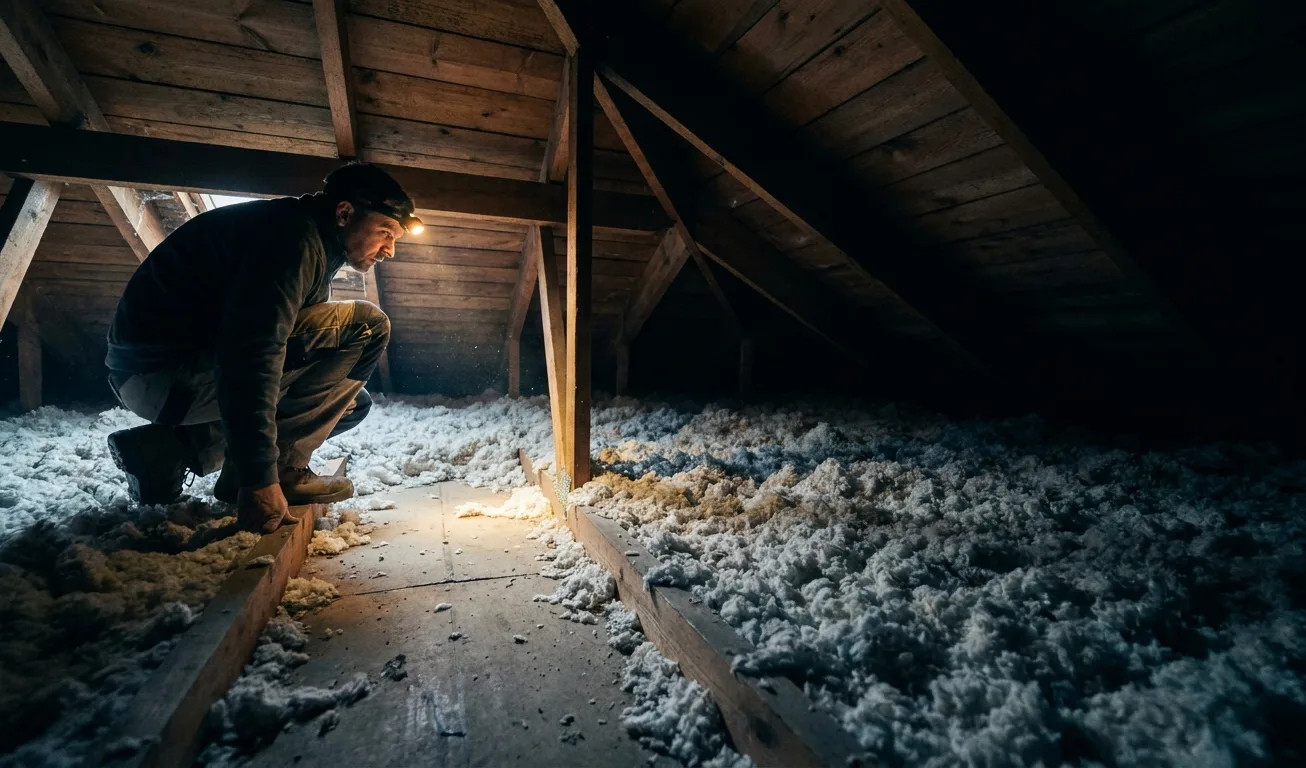
The void is entered and walked rather than looked into from the hatch. What we are reading up there is the pattern the animals have left in the insulation and on the timber: flattened runs through blown insulation, droppings concentrated along beams and at junctions, greasy rub marks where fur has passed the same edge repeatedly, gnawing on rafters and cable, and nesting material pulled together in a corner or against a chimney.
That pattern is the map. Traps go on the runs it describes, against the timber, on the routes the animals are already committed to. This is the part that cannot be done from the ground floor, and it is why traps set in a kitchen achieve nothing while the ceiling carries on being noisy.
What Is Happening to the Building
Insulation
Blown insulation is compressed flat along every run, which costs some of its thermal value, and it is soiled with urine and droppings in the areas of heaviest use. On a population that has been in place for a season or more, the material along the main runs generally needs removing and replacing rather than cleaning. Spraying over contaminated insulation is a cosmetic answer to a real problem. It is the single most common job Rodent Control Las Vegas runs in a given month.
Cable
This is the part of a roof rat infestation that matters most and gets discussed least. Rodent incisors grow continuously and have to be worn down, and cable sheathing is a convenient material to do it on. We look for gnawed wiring on every attic job and photograph what we find. Where sheathing is breached, our advice is always the same and always the same tone: get an electrician to it, promptly. It is a fire risk, and repairing it is not our trade.
Ducting and Pipework
Flexible ducting gets torn open and used as a route, which quietly wrecks the efficiency of an air-conditioning system and vents conditioned air into a roof void. Water lines get gnawed occasionally, and in a roof space a slow leak can run for a long time before anything shows on a ceiling below.
Closing the Roofline
Once the void has gone quiet, the building gets closed. On valley housing stock the openings are consistent: the gap where a tiled roof meets the fascia board, which on many roofs is open along its entire length; gable and attic vents with perished or absent screening; the point where an air-conditioning line set enters a wall; and tile lines lifted enough at a ridge or valley to admit an animal that only needs an inch and a half.
All of it is closed with metal — galvanised steel mesh, hardware cloth, metal flashing. Nothing that gets sealed with expanding foam stays sealed, because foam is soft, and a rat that got in there once will simply chew it back open. We photograph each opening before and after, which is the only practical way for you to see work that happens on a roof and in a void you will never visit.
The Yard Is Half the Job
Sealing a roof while the garden continues to support a population outside manages the problem rather than ending it. On most valley properties there are three things worth dealing with.
Palms
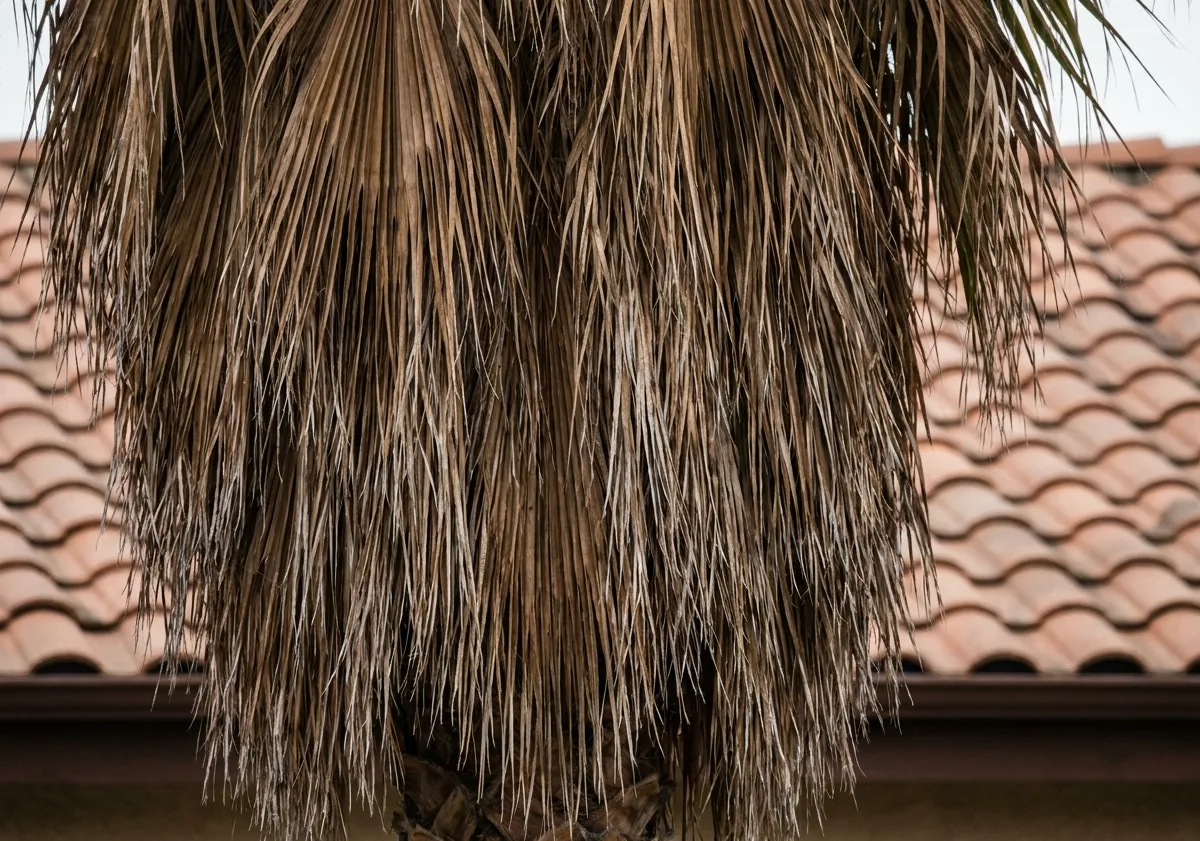
An untrimmed palm keeps a dense skirt of dead fronds beneath the crown. It is dry, sheltered, hidden from owls and hawks, and on a great many properties it is close enough to the roof to serve as a bridge. Roof rats nest in them readily. Trimming the skirt out and cutting fronds back clear of the tiles removes a nest site and a route in the same afternoon, and on some properties it is the single most effective thing anyone does.
Fruit
Citrus, figs, olives, dates and pomegranates all hold rat populations, particularly when fruit is allowed to fall and lie. A tree does not have to be removed. Picking promptly, clearing windfall and keeping branches cut back off the roofline takes away the food and the access without taking away the tree.
Block Walls
Rats move along the tops of block walls the way we use pavements — continuous, elevated, sheltered, and connecting one garden to the next for the length of a street. This is why roof rats tend to be a neighbourhood matter rather than a single-property one. We cannot change your neighbours' gardens, but the rub marks along a wall top tell us which direction the pressure is coming from, and that is worth knowing before deciding where the exclusion effort goes.
Afterwards
Cleanup closes the job: droppings and nesting material removed, soiled insulation replaced, the void treated to deal with the scent that would otherwise advertise the space to the next animal along the wall. Then we come back, because the point of a follow-up is to check the seals under real conditions rather than to sell another visit. If the void is quiet and nothing new has opened, that is the end of it.
★ FAQ
Frequently Asked Questions
Roof rats are most active in the first few hours after dark and again before dawn. Scratching or scurrying that starts reasonably promptly after sunset, runs along a line rather than staying in one place, and comes from above the ceiling is close to diagnostic. Noise from a single fixed spot that continues through the day is more likely to be a bird, and a heavier, slower shuffle can be something larger in a wall.
Usually the roof rather than the house. A tiled roof with an open gap along the fascia, a palm with an untrimmed skirt, an overhanging branch, or an unscreened attic vent gives a way in that a neighbouring property may simply not have. Roof rats are also a street-level problem more than a house-level one -- they travel the block walls -- so it is common for a whole run of gardens to hold the population and for one building to be the one that is open.
No, and anyone who says otherwise is selling you a return visit. The runs are in the roof void, and traps have to sit on them. We work attics through the cooler part of the day in summer for obvious reasons, but the work is up there.
Some of the pressure eases, but an established roof rat population does not move out because it got warmer. Once a nest is in a roof void with insulation to shred and a route to a fruit tree, there is little reason to leave. The seasonal pattern changes how many are coming in, not whether the ones already there stay.
Flattening it, tunnelling through it and soiling it. Blown insulation gets compressed along the runs, which costs you some of its value, and urine and droppings accumulate in the same places over months. On a long-running infestation the insulation along the main runs usually needs removing and replacing rather than cleaning.
Yes, and it is the part of this we take most seriously. Rodent incisors grow continuously and cable is a convenient thing to wear them down on. We look for gnawed cable on every attic inspection and photograph what we find. Where the sheathing is breached we will tell you plainly to get an electrician to it, because that is a fire risk and not something we are qualified to repair.
The trapping usually runs one to three weeks with visits to check and reposition. Sealing the roofline is normally a single visit once we know what needs closing. If the insulation is soiled enough to need replacing, that is a separate day's work and we will quote it once you have seen the photographs.
📍 On the map
How We Clear a Roof Rat Population
Into the void, onto the runs, then close the roofline
The attic gets entered and walked. Droppings, rub marks and flattened insulation show the circuit the animals are running, and traps go on it. Once the catch stops, the roofline is closed -- fascia gaps, vents and tile lines in metal and mesh -- and the soiled insulation comes out. The last part happens outside: the palm skirts, branches and fruit that made your roof reachable in the first place.